

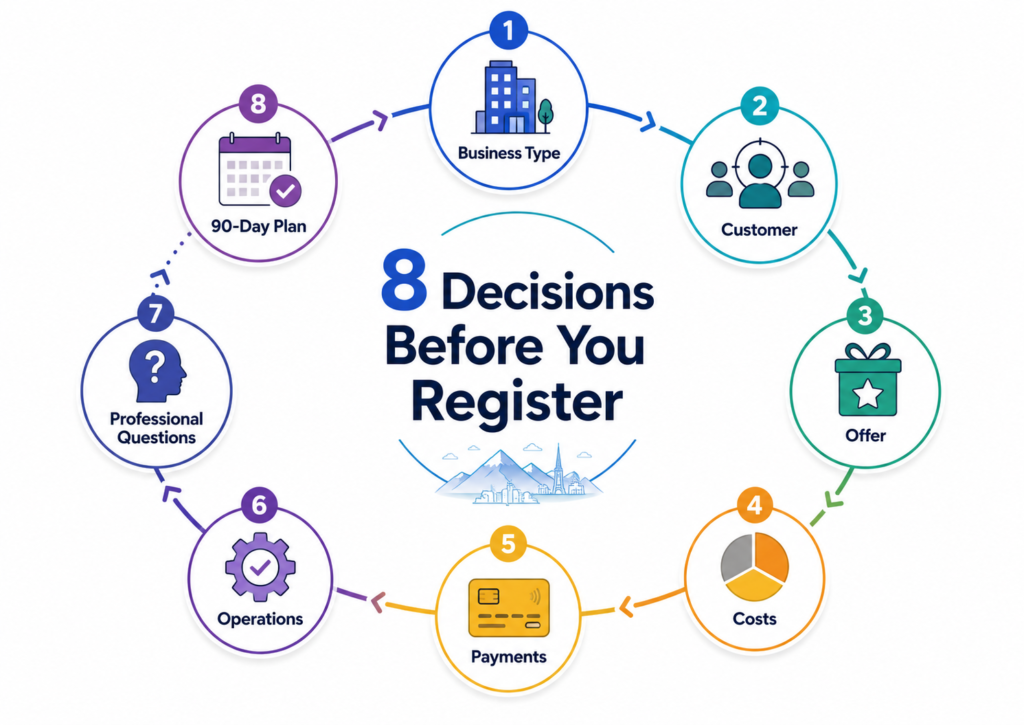
Starting a business in Armenia involves more than choosing a legal structure and submitting registration documents. Before you register, clarify what kind of business you are building, who will buy from you, what you will sell, how the business will earn and receive money, what the first six months will cost, how daily operations will work, which questions require an Armenian accountant or lawyer, and what your first 90 days should achieve.
A founder can complete the registration process correctly and still face serious gaps a few months later. The chosen payment setup may not suit international clients. The monthly costs of a physical location may be higher than expected. Importing goods may create cash-flow and logistics demands that were never included in the original plan. The founder may even struggle to explain clearly who the customer is and why that customer would pay.
These problems do not necessarily mean the registration decision itself was wrong. They usually mean registration was treated as the whole plan, rather than one step inside a broader commercial and operational plan.
This article focuses on the business thinking that should happen before or alongside legal registration. It does not provide legal, tax, accounting, immigration, or banking advice, and it is not a step-by-step registration guide.
Armenia provides both online and in-person business-registration services. According to Armenia’s National Services Gateway, LLCs and individual entrepreneurs can currently be registered online when the registrant has the required identification and digital signature. In-person registration is available to Armenian and foreign citizens. Official guidance also shows that standard LLC registrations may be processed quickly once the correct documents are ready. (Hartak)ed is useful, but it creates a risk: the paperwork may be ready before the business is.
Starting a Business in Armenia: The 8 Decisions at a Glance
| Decision | Main question | Why it matters |
|---|---|---|
| 1. Business type | What am I actually building? | It affects premises, logistics, payments, staffing, permissions, and professional advice. |
| 2. Customer | Who will buy, and where are they? | Registration creates a legal entity. It does not create demand. |
| 3. Offer and revenue model | What is the customer paying for, and how will revenue be earned? | It shapes pricing, margins, sales frequency, and cash flow. |
| 4. Launch and six-month costs | What must be paid before the business produces reliable income? | Registration is only one small part of the real startup cost. |
| 5. Payment flow | How will money move from the customer to the business account? | A weak payment setup can delay sales and complicate record-keeping. |
| 6. Operating model | How will the business function day to day? | It determines the need for local support, suppliers, contractors, staff, and systems. |
| 7. Professional questions | What should I ask an Armenian accountant and lawyer? | Better questions reduce guesswork and help professionals give more relevant advice. |
| 8. Ninety-day plan | What must happen before and after registration? | It connects registration to a practical sequence of validation, preparation, and launch. |
1. Decide What Kind of Business You Are Actually Building
“Starting a business” can describe very different operating realities. A consultant serving clients in Europe has little in common operationally with a café in central Yerevan or a company importing physical products for online resale. All three may register a business in Armenia, but their risks, costs, payment needs, and daily processes will be different.
The type of business you are building affects whether you need premises, equipment, inventory, suppliers, licences, customs support, delivery partners, employees, insurance, contracts, data protection, or cybersecurity measures. Some decisions can be adjusted later with limited cost. Others, such as signing a long lease, buying inventory, or entering a partnership, may be expensive to reverse.
Start by defining what you will sell. Will it be a service, physical product, digital product, access, subscription, or a combination? Decide whether customers will interact with the business in person or remotely, whether you will hold inventory, and whether importing or exporting is part of the model.
You should also identify any activity that may require professional confirmation, a licence, a permit, or sector-specific compliance. Avoid assuming that a general registration allows every type of activity. The requirements will depend on what the business actually does.
An English-language consultant serving clients abroad will need a workable invoicing and international-payment process. A café needs premises, equipment, staff scheduling, suppliers, food-related professional checks, and daily cash controls. A product business may need inventory planning, storage, customs support, delivery, and returns management.
The useful question is not simply, “What company should I register?” It is, “What operating reality am I committing to?”
2. Decide Who Will Buy and Where Your Customers Are
Registering a company gives you a legal entity. It does not give you a customer.
Before spending heavily on business setup in Armenia, decide whether your customers will be located in Armenia, abroad, or in both markets. Clarify whether you are selling to businesses or individuals, who experiences the problem, and who actually controls the purchasing decision.
For some businesses, the user and the buyer are the same person. In others, especially B2B services, training, software, and employee benefits, the person using the service may be different from the manager or department paying for it.
Language also affects the commercial model. Which language will you use in marketing, sales conversations, customer support, contracts, invoices, and service delivery? Depending on your audience, you may need English, Armenian, Russian, Persian, or a combination. The need for language support can affect hiring, partnerships, marketing costs, and customer trust.
Try to describe how you will reach your first ten paying customers. “Social media” or “advertising” is not specific enough. Identify the communities, partnerships, search terms, direct outreach, physical locations, referrals, or sales conversations that could realistically produce the first customers.
Interest is useful, but it is weaker than buying behaviour. A friend saying they like the idea is not the same as a customer paying for it. Low-cost validation methods include customer interviews, competitor research, pilot offers, small-scale outreach, landing-page tests, pre-orders where appropriate, and letters of intent for realistic B2B opportunities.
[INTERNAL LINK: Read our future guide to finding your first customers in Armenia.]
The goal is not to prove that the business will definitely succeed. The goal is to gather enough evidence that a reachable customer problem exists before you make expensive commitments.
3. Define the Offer and Revenue Model
There is a difference between the product or service, the outcome the customer receives, the way the offer is priced, and the way revenue enters the business.
A consultant may sell a project, an advisory session, a retainer, or a fixed-scope package. A software company may use subscriptions, licensing, usage-based pricing, or a freemium model. A product business may earn through retail margin, wholesale margin, commission, or repeat purchases.
Write down exactly what the customer is paying for. Is the payment linked to time, access, a completed project, a product, a result, or ongoing support? Is the revenue one-time or recurring? How frequently is the customer likely to buy again?
Then calculate the costs connected to each sale. These may include payment fees, delivery, packaging, commissions, materials, contractor time, refunds, customer support, taxes, and accounting. A price that looks profitable before these costs are included may produce a much smaller margin in practice.
For example, an international consultant may charge a healthy project fee but lose part of the margin through payment costs, currency conversion, and unpaid administrative time. A retailer may have a strong list price while packaging, shipping, returns, and unsold stock reduce the real margin. A subscription business may generate recurring revenue but still struggle if customer acquisition is expensive or customers cancel quickly.
Also consider revenue concentration. Depending heavily on one customer, one sales channel, or one payment method creates vulnerability. It may be acceptable during an early pilot, but it should be recognised and managed.
Avoid looking for one universal pricing formula. Your pricing needs to fit the value created, customer expectations, direct costs, operating costs, competitive context, and the amount of revenue the business needs to remain sustainable.
4. Estimate the Real Cost of Launch and the First Six Months
Registration cost is only one part of starting a company in Armenia. The more important question is how much cash the business will require before it begins producing reliable income.
Potential costs include professional advice, translation and notarisation, accounting, bookkeeping, banking, payment processing, deposits, rent, equipment, software, a website, initial marketing, inventory, packaging, shipping, customs, insurance, payroll, contractors, licences, tax reserves, refunds, and delayed customer payments.
The founder’s personal living costs may also matter. When a business is funded through savings, the same financial reserve may need to support both the company and the founder for several months.
It helps to prepare three scenarios:
| Cost category | Minimum scenario | Realistic scenario | Higher-cost scenario |
|---|---|---|---|
| One-time startup costs | Only essential setup | Likely setup for the chosen model | Additional setup, professional work, or rework |
| Fixed monthly costs | Lean or home-based operation | Expected monthly operation | Higher rent, staffing, tools, or support |
| Variable costs per sale | Lowest likely fulfilment cost | Expected cost per transaction | Higher delivery, payment, material, or refund costs |
| Time before reliable revenue | Early customer acquisition | Expected sales cycle | Slower launch or payment collection |
| Working-capital reserve | One to two months | Three to four months | Six months or more |
| Owner’s living costs | Covered separately | Partly supported by savings | Fully dependent on the same reserve |
| Contingency | Small emergency buffer | Moderate buffer | Delays, replacement costs, or unexpected compliance needs |
Separate one-time startup costs from fixed monthly costs, variable costs, working capital, personal living needs, and the emergency reserve. They behave differently and should not be combined into a single startup number.
Ask how much must be paid before the first sale, how long it could take to receive the first customer payment, and how many months the founder can operate without reliable revenue. Identify which commitments can be reduced or delayed until demand is clearer.
It is also useful to calculate an approximate break-even point. You do not need a perfect forecast. You need a realistic view of how many sales or customers the business requires to cover its ongoing costs.
Planning the Business Before Registration
Before committing to a legal structure, lease, team, or payment setup, review whether the business model and operating plan are workable. Novamentis can help you examine the cost assumptions, payment flow, and priorities for the first 90 days.
5. Map How Customers Will Pay and How Money Will Move
This section is especially important for foreign founders, freelancers, agencies, SaaS companies, e-commerce sellers, and anyone serving customers outside Armenia.
The full payment path looks like this:
Customer → invoice or checkout → payment method → currency conversion or intermediary → business account → bookkeeping record → tax and reporting process
Every part of this flow needs to support the actual business model. A method that works for one occasional payment may not work well for recurring billing, high transaction volumes, refunds, multiple currencies, or customers in different countries.
Start with the customer. Do they expect to pay by bank transfer, card, online checkout, cash, or another compliant method? Will they accept the payment process you are planning to use? Consider the currencies involved, processing fees, intermediary-bank fees, settlement times, refunds, chargebacks, recurring billing, and delayed payments.
Then consider documentation and record-keeping. How will each transaction be matched with an invoice or accounting document? How will currency conversion be recorded? Who will reconcile the business account with bookkeeping records?
Armenia’s National Services Gateway states that Armenian banks generally provide services to residents and non-residents, while account eligibility, documents, fees, and approval procedures vary by bank and applicant. Non-resident applicants may be asked for identification, proof of address, the purpose of the account, economic ties to Armenia, and evidence of income or source of funds. Banks may request additional documentation case by case. (Hartak) reason, avoid building the entire business model around an assumed banking or payment solution. Confirm requirements directly with the chosen bank or provider and, where possible, test the complete journey with a small real transaction.
Also prepare a compliant backup. Payment providers can change their eligibility rules, banks may request additional documents, and a customer may refuse to use the preferred payment method. A backup process reduces disruption without relying on informal workarounds.
6. Decide How the Business Will Operate Day to Day
A registered company still needs someone to handle customer communication, invoicing, supplier follow-up, documents, deadlines, quality control, and daily decisions.
Decide whether the business will be home-based, office-based, shop-based, or remote. Consider whether the founder will be present in Armenia or manage the business from another country. Map suppliers, fulfilment, inventory, delivery, customer support, working hours, basic tools, and recurring administrative tasks.
Identify which activities genuinely require a local person. Armenian- or Russian-language support may be useful for suppliers, customers, service providers, official communication, or employees. Other activities may be managed in English or remotely.
Ask whether the founder can run the business alone at first. A contractor, accountant, lawyer, adviser, virtual assistant, local representative, or part-time employee may solve a specific need without requiring a full partnership or permanent hire.
A local partner should be chosen because they contribute real commercial value, expertise, capital, relationships, or operating capability. Unfamiliarity with local procedures alone is usually better addressed through professional support.
When a partnership is genuinely appropriate, define roles, responsibilities, decision authority, financial contributions, access to accounts, ownership, and what happens if one person leaves. These matters should be documented and professionally reviewed.
Early systems also matter. Decide how customer information, invoices, contracts, supplier documents, passwords, deadlines, and recurring tasks will be organised. Basic structure from the beginning makes later hiring and delegation easier.
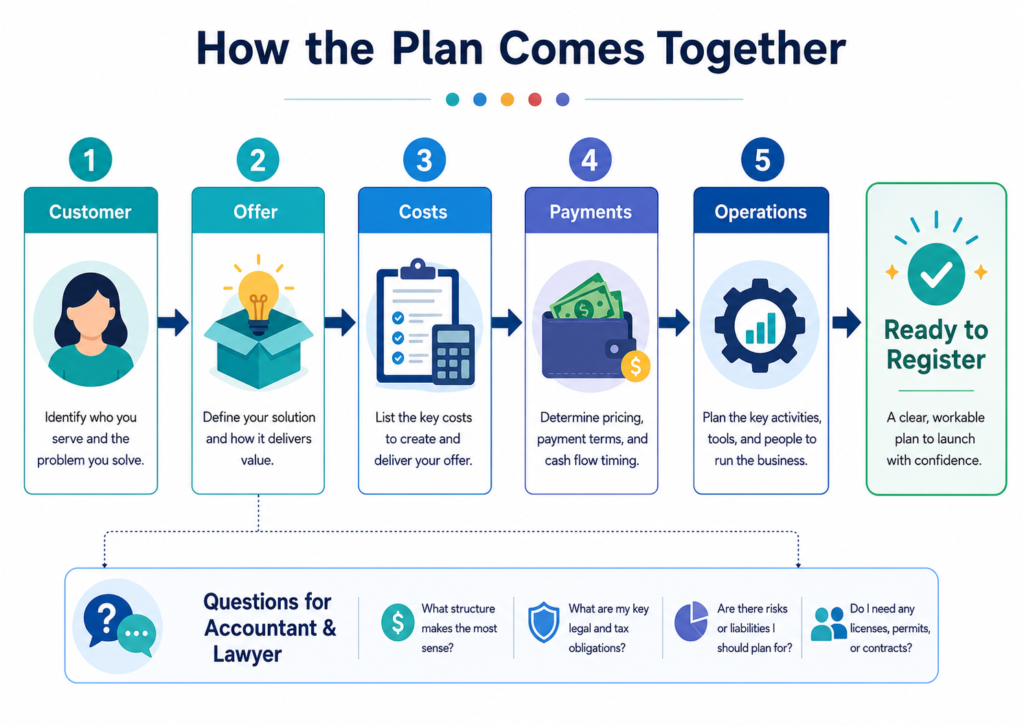
7. Prepare the Right Questions for an Armenian Accountant and Lawyer
This section is designed to help you prepare for professional conversations. It does not answer the legal, tax, immigration, accounting, or banking questions on your behalf.
Business planning should come first because your adviser needs to understand what you sell, where the customers are, how payments move, whether you will employ people, and whether goods or services cross borders.
| Topic | Question for the professional | Why the answer affects the business |
|---|---|---|
| Legal structure | Which available structure fits the ownership, liability, management, and future plans of this business? | The answer affects responsibility, control, administration, and future ownership changes. |
| Foreign ownership and management | What obligations apply to foreign founders, owners, directors, or authorised representatives? | It may affect documents, signatures, reporting, and practical administration. |
| Documents and ongoing filings | Which documents, translations, declarations, beneficial-ownership reports, and ongoing filings will be required? | These obligations create deadlines, administrative work, and professional costs. |
| Contracts | What should be included in founder, shareholder, supplier, employment, lease, and customer agreements? | Contracts influence risk, payment, responsibilities, and dispute management. |
| Licences and regulation | Does this specific activity require a licence, permit, insurance, professional approval, or sector-specific registration? | The answer may affect whether and how the business can operate. |
| Tax regime | Which tax regimes may apply to this activity, and what determines eligibility? | Tax treatment can affect pricing, cash flow, and reporting. |
| VAT and other obligations | When could VAT, profit tax, payroll-related obligations, or other taxes apply? | Different obligations may begin at different stages of the business. |
| Invoicing and records | How should local and international revenue be invoiced, recorded, and retained? | A clear process reduces errors and makes reporting easier. |
| Foreign currency | How should foreign-currency transactions, conversion, and fees be handled in the accounts? | This affects bookkeeping and the accuracy of financial reports. |
| Accounting support | How often will reports and filings be required, and what will ongoing accounting support cost? | Professional costs belong in the operating budget. |
| Employees and contractors | What changes if the company hires employees, uses contractors, or works with foreign specialists? | Employment and contracting can create different registration and reporting duties. |
| Immigration and residence | Does the founder’s residence or immigration status affect management, employment, or operations? | Business ownership and the right to work or reside may involve separate questions. |
| Imports and exports | What customs, documentation, tax, or reporting questions apply if goods or services cross borders? | Cross-border activity can affect cost, timing, pricing, and cash flow. |
| Banking and compliance | What documents are banks likely to request for onboarding and ongoing compliance? | The business may need to prepare contracts, invoices, ownership records, and source-of-funds evidence. |
| Data and consumer obligations | Do data-protection, consumer-protection, cybersecurity, refund, or privacy requirements apply? | These requirements affect systems, contracts, websites, and customer processes. |
| Related parties | Are there additional requirements if the business trades with founders, affiliated companies, or related parties? | These arrangements may require specific documentation or treatment. |
A business consultant can help you understand the commercial implications of these questions and prepare the information your advisers need. Final legal, tax, accounting, immigration, employment, and banking decisions must be confirmed with qualified Armenian professionals and relevant official institutions.
8. Build a 90-Day Launch Plan Before You Register
A registration date should sit inside a practical sequence of work. It should not replace the sequence.
Days 1–30: Validate and Clarify
Define the customer, problem, offer, and revenue model. Speak with potential customers, review alternatives, and test demand through interviews, outreach, a pilot, or another low-cost method.
Map the likely payment flow, estimate startup and six-month costs, and write down the assumptions that still need evidence. Prepare the questions that must be discussed with an accountant, lawyer, bank, or other specialist.
Days 31–60: Prepare the Operating Foundation
Confirm legal and accounting decisions with qualified professionals. Prepare the budget and cash-flow forecast, identify the basic systems you need, and organise contracts, documents, invoicing, and bookkeeping processes.
Test the payment journey, confirm supplier or contractor arrangements, define responsibilities, and prepare a simple sales process. Decide which activities the founder can manage alone and which require local or specialist support.
Days 61–90: Launch, Measure, and Adjust
Begin with a controlled offer, pilot, limited inventory order, or small-scale launch where appropriate. Track leads, conversion, collected revenue, actual costs, payment delays, customer feedback, and recurring operational problems.
Document repeated tasks while the business is still manageable. Delay unnecessary hiring, long-term commitments, or heavy marketing expenditure until the early evidence supports them.
Adjust the offer, pricing, channel, or process based on what customers and financial results show.
Create clear decision gates:
- What must be true before registration?
- What must be true before signing a lease?
- What must be true before hiring?
- What must be true before buying substantial inventory?
- What must be true before spending heavily on marketing?
Not every business needs to complete every activity before registration. The important point is to know which assumptions have been tested, which remain uncertain, and how much money is being committed while that uncertainty remains.
How Pre-Registration Decisions Change by Business Type
| Business type | Main customer question | Main cost risk | Main payment question | Main operating issue | Professional checks likely to be needed |
|---|---|---|---|---|---|
| Consultant or agency serving foreign clients | Is there enough reachable demand at the planned price? | Underestimating unpaid work, accounting, and international-payment costs | Can clients pay in the expected currencies through a practical method? | Contracts, scope control, time zones, and delivery capacity | Structure, invoicing, foreign revenue, banking, and tax treatment |
| Local service business | Is the local market large and accessible enough? | Underpricing labour, rent, tools, or customer-acquisition costs | How do local customers expect to pay? | Scheduling, quality control, customer support, and language | Activity requirements, employment, contracts, tax, and insurance |
| Shop, café, or physical venue | Will sufficient demand reach this location? | Rent, deposit, equipment, fit-out, staffing, and waste | How will cash and card payments be managed and recorded? | Suppliers, staff, stock, opening hours, and daily controls | Premises, sector-specific permits, employment, safety, and insurance |
| Product, e-commerce, import, or export business | Where is the buyer, and how will they discover and receive the product? | Inventory, customs, shipping, storage, returns, and damaged stock | Which payment method works across the customer’s country and currency? | Logistics, fulfilment, stock control, and returns | Customs, contracts, tax, consumer rules, and product requirements |
| SaaS or digital product | Will customers repeatedly pay for this specific problem? | Development, support, customer acquisition, and churn | Can the business support recurring international billing? | Support, uptime, access management, data, and security | Tax treatment, data protection, contracts, and cross-border payments |
Common Mistakes Founders Make Before Registering in Armenia
These mistakes often happen because completing visible tasks feels like progress. Recognising them early makes the remaining uncertainty easier and less expensive to manage.
- Registering before confirming that a reachable customer will pay. The legal entity exists before the demand has been tested.
- Choosing a structure only because it appears cheap or simple. Cost and speed are only part of the decision. Ownership, liability, activity, future plans, and administration also matter.
- Assuming a bank account or payment platform will automatically solve international payments. The customer’s preferred method, eligibility, documentation, currency, fees, and settlement process need to be tested.
- Budgeting for registration while ignoring six months of operating costs. Rent, accounting, payment fees, inventory, delays, and the founder’s living costs often matter more than the registration fee.
- Signing a lease or hiring before demand is sufficiently clear. Fixed commitments reduce the time available to learn and adjust.
- Selecting a partner mainly to overcome language or unfamiliarity with local procedures. Specific advisers or contractors may solve those needs without creating a permanent ownership relationship.
- Mixing personal and business money without a clear record system. This makes accounting, cash-flow decisions, and business performance harder to understand.
- Using old forum discussions as a substitute for current professional confirmation. Procedures, bank practices, thresholds, and requirements can change.
- Ignoring how the business type changes the plan. A consultant, café, importer, and software business require different assumptions, checks, and operating systems.
- Leaving accounting until after revenue starts. The earliest transactions still need appropriate invoices, records, and supporting documents.
Pre-Registration Business Checklist
Use this checklist to identify unanswered questions. It is designed to complement the article rather than replace the planning work.
- Business type clarified
- Physical, remote, product, service, or hybrid model defined
- Target customer described specifically
- Customer location and language identified
- Demand tested through real evidence
- Offer described clearly
- Revenue model selected
- Pricing assumptions tested against costs
- One-time startup costs estimated
- Fixed and variable costs separated
- Six-month cash requirement estimated
- Owner’s living costs considered
- Payment journey mapped from customer to bookkeeping
- Bank, KYC, currency, and fee questions identified
- Backup payment method considered
- Operating location selected
- Suppliers, inventory, delivery, and logistics mapped where relevant
- Team, contractor, adviser, and partner needs clarified
- Armenian, Russian, English, or other language support identified
- Questions for an accountant prepared
- Questions for a lawyer prepared
- Immigration, employment, regulatory, and banking questions listed
- Basic systems for invoices, documents, customers, and tasks selected
- First ten-customer plan drafted
- Ninety-day milestones and decision gates defined
When a Business Consultant Can Help and When You Need a Specialist
Novamentis supports the business side of pre-registration planning. We can help you clarify the business model, define the customer and offer, examine pricing and cost assumptions, map the payment and invoicing workflow, design the operating model, organise the questions for professional advisers, and build a practical 90-day action plan.
Novamentis does not provide legal opinions, registration services, tax advice, tax filing, bookkeeping, accounting, immigration advice, bank-account approval, payment-provider guarantees, or licence approval.
These matters must be handled by qualified Armenian professionals and the relevant institutions. Our role is to help you understand the commercial and operational picture so you can make better use of those specialist conversations.
Need a Second Set of Eyes Before You Register?
Before committing to a legal structure, lease, team, inventory order, or payment setup, review whether the business itself is commercially and operationally ready.
Novamentis can help you clarify the model, identify unanswered questions, review the major assumptions, and build a practical 90-day plan. Final legal, tax, accounting, immigration, and banking decisions should then be confirmed with the appropriate Armenian professionals.
[Book a Business Clarity Consultation](INTERNAL LINK: Book a Business Clarity Consultation)
[Ask a Question on WhatsApp](INTERNAL LINK: Contact Novamentis)
Founders relocating from another country can also review our [Foreign Founders in Armenia support](INTERNAL LINK: Foreign Founders in Armenia service/page).
Already registered and now discovering gaps? Our [Business Review and 90-Day Action Plan](INTERNAL LINK: Business Review and 90-Day Action Plan service) can help you assess the current model and prioritise the next steps.
For support with budgets, costs, and cash assumptions, see [Business Planning and Financial Readiness](INTERNAL LINK: Business Planning and Financial Readiness service).
Frequently Asked Questions About Starting a Business in Armenia
1. What should I decide before registering a business in Armenia?
Clarify the business type, target customer, offer, revenue model, pricing assumptions, startup costs, payment flow, daily operations, and first 90-day priorities. You should also identify which questions require confirmation from an Armenian accountant, lawyer, bank, immigration professional, or official institution.
2. Do I need a business plan before registering a company in Armenia?
You do not necessarily need a long, formal document. You do need a working plan that explains who the customer is, what the business sells, how revenue will be earned, how customers will pay, what the first six months may cost, and what assumptions remain untested.
A concise and realistic plan is usually more useful at this stage than a polished document built on weak assumptions.
3. Can a foreigner start a business in Armenia?
Armenia’s National Services Gateway states that foreign citizens can apply for business registration in person. LLC and individual-entrepreneur registration can also be completed online when the registrant meets the relevant identification and digital-signature requirements. Documents and procedures depend on the chosen structure and the founder’s circumstances, so confirm the current requirements through the official register or a qualified Armenian professional. (Hartak)hould I choose an LLC or an individual entrepreneur structure in Armenia?
The answer depends on ownership, liability, activity, expected revenue, tax treatment, management, future partners, and reporting needs. Avoid choosing only because one option appears cheaper or faster.
Prepare your business assumptions first, then review them with a qualified Armenian accountant or lawyer before making the final decision.
5. Do I need an accountant before registering?
Speaking with an accountant before registration can help you understand how the planned activity, customers, revenue, expenses, employees, and cross-border transactions may affect bookkeeping and tax obligations.
The accountant should understand how the business will actually operate. A general question such as “Which regime is cheaper?” is less useful than showing them the expected revenue model, costs, currencies, customers, and transactions.
6. How should I plan to receive payments from customers outside Armenia?
Map the complete payment journey from the customer to the business account and accounting records. Consider currency, customer preference, fees, settlement time, required documents, invoices, refunds, and backup methods.
Bank requirements vary by applicant and institution. Confirm eligibility and documents directly with the chosen bank or provider before relying on a payment route. (Hartak)o I need a local partner or employee?
It depends on the business model. A local partner is not automatically necessary because the founder is unfamiliar with Armenian procedures or language.
A contractor, adviser, employee, accountant, lawyer, translator, or local representative may solve a specific need. A partner should contribute lasting commercial value and should enter the business with clearly documented roles and responsibilities.
8. Can I operate an Armenian business remotely?
Some service and digital businesses may be managed largely remotely, while physical, regulated, retail, hospitality, or product-based operations may require more local involvement.
Banking, signatures, official procedures, suppliers, employees, customer support, or document handling may also create local needs. Confirm the legal, tax, immigration, and practical requirements for your structure and activity before relying on a fully remote model.
9. What costs should I budget for besides registration?
Consider professional advice, translation, accounting, banking, payment fees, software, equipment, website costs, marketing, rent, deposits, inventory, delivery, customs, insurance, payroll, contractors, tax reserves, refunds, payment delays, working capital, and the founder’s living costs.
Separate one-time startup costs from monthly and per-sale costs.
10. What should my first 90-day business plan include?
Use the first 30 days to clarify and validate the customer, offer, revenue model, costs, and payment flow. Use the next 30 days to confirm professional decisions and prepare systems, contracts, budgets, suppliers, and sales processes.
Use the final 30 days for a controlled launch, measurement, documentation, and adjustment.
11. What should I do if I have already registered without making these decisions?
You do not necessarily need to start again. Work through the eight decisions now and identify the gaps that create the greatest financial or operational risk.
Prioritise payment problems, unclear customers, weak margins, unmanaged fixed costs, missing accounting processes, and commitments that may become more expensive over time. Turn the results into a focused 90-day correction plan.
Disclaimer
Novamentis provides general business planning, management, and operational guidance. We are not a law firm, accounting firm, tax adviser, immigration adviser, bank, or payment institution.
Legal structures, tax treatment, licences, employment obligations, banking requirements, immigration matters, and official procedures in Armenia may change and depend on the founder’s circumstances and business activity. Confirm these matters with qualified Armenian professionals and the relevant official institutions before acting.
About the Author
Sarah Moradi is a business consultant, trainer, and founder/director of Novamentis LLC in Armenia. She helps small and founder-led businesses clarify decisions, build practical systems, and turn business priorities into actionable plans. Message her on linkedin.