

If you’ve ever sat in a meeting where someone confidently said “we should go Agile” — and you nodded along while quietly wondering what that actually means for your day-to-day operations — you’re not alone.
Lean vs Agile is one of the most searched, most misunderstood comparisons in business operations. Both are powerful. Both have helped companies across industries grow faster, waste less, and work smarter. But choosing the wrong one, or applying the right one the wrong way, can cost you months of effort and create more confusion than clarity.
This article breaks both methodologies down in plain language, helps you understand the real differences, and most importantly, helps you figure out which one actually fits your business right now.
What Are Lean and Agile? A Clear Overview
Before comparing them, let’s make sure we’re talking about the same things.
What Is Lean?
Lean is a business methodology focused on eliminating waste and maximizing value from the customer’s perspective. It originated in Toyota’s manufacturing system in post-WWII Japan and was later adapted for businesses of all types.
The core idea is simple: look at every step in your process and ask, “Does this create value for the customer?” If the answer is no, it’s waste. Lean gives you tools to find that waste, reduce it, and build a more efficient operation.
Key principles of Lean:
- Define value: from the customer’s point of view
- Map the value stream: identify every step that contributes to delivery
- Create flow: remove bottlenecks so work moves smoothly
- Establish pull: produce based on demand, not assumption
- Pursue perfection: continuous improvement never stops (called Kaizen)
Lean is especially powerful for businesses with repetitive processes, production cycles, or service delivery that follows a consistent path.
What Is Agile?
Agile is a project and product development methodology built on flexibility, iteration, and collaboration. It was formalized in 2001 through the Agile Manifesto, originally created by software developers frustrated with rigid, slow project management approaches.
The core idea: instead of planning everything in advance and delivering once, you work in short cycles (called sprints), get feedback early, and adjust as you go.
Key principles of Agile:
- Individuals and interactions over processes and tools
- Working results over comprehensive documentation
- Customer collaboration over contract negotiation
- Responding to change over following a fixed plan
Agile is powerful when you’re dealing with uncertainty, evolving customer needs, or complex creative and knowledge work.
Lean vs Agile: Pros and Cons
Neither methodology is perfect for every situation. Here’s an honest look at what each one does well — and where it falls short.
Lean: Pros and Cons
| Pros | Cons |
|---|---|
| Reduces waste and operational costs | Can be rigid if applied too mechanically |
| Creates clear, repeatable processes | Takes time to map and optimize workflows |
| Works well across industries (not just manufacturing) | Requires strong buy-in from the full team |
| Focuses on long-term efficiency | Slower to adapt when conditions change quickly |
| Easier to measure and quantify results | Can stifle creativity if over-systematized |
Lean works best when your processes are (or should be) consistent and repeatable, and you want to cut costs, improve delivery time, or reduce errors without reinventing the wheel every week.
Agile: Pros and Cons
| Pros | Cons |
|---|---|
| Highly adaptable to change | Can create chaos without disciplined execution |
| Faster feedback loops and course correction | Difficult to predict timelines and budgets |
| Keeps customers involved throughout | Requires team members who can handle ambiguity |
| Encourages collaboration and creative problem-solving | Documentation often falls behind |
| Great for innovation and product development | Can lead to scope creep if not managed |
Agile works best when you’re working on something that evolves, a product, a campaign, a service model, where customer feedback should shape the outcome as you go.
When to Use Lean vs When to Use Agile
This is the question most business owners really want answered: which one do I actually use?
Here’s a practical way to think about it.
Use Lean When:
Your biggest problem is inefficiency or inconsistency.
If your team keeps reinventing the wheel, your delivery times are unpredictable, your costs are creeping up, or the same mistakes keep happening, Lean is your tool. It’s built to stabilize and optimize what you already do.
Ask yourself:
- Do we have a process that should be working better than it is?
- Are there clear steps to what we do, but we’re not following them consistently?
- Is waste (time, money, rework) eating into our margins?
If yes, start with Lean.
Examples of businesses that benefit from Lean:
- Service businesses with defined delivery workflows (accounting, legal, healthcare, logistics)
- Small manufacturers or product-based businesses
- E-commerce operations with fulfillment processes
- Any business where customer experience depends on consistent execution
Use Agile When:
Your biggest problem is uncertainty or rapid change.
If you’re building something new, responding to a fast-moving market, or developing a product or service where requirements shift frequently, Agile gives you the structure to move fast without breaking everything.
Ask yourself:
- Are we creating something that doesn’t fully exist yet?
- Does our work require frequent input from clients or customers?
- Do conditions change faster than our plans can keep up with?
If yes, Agile fits better.
Examples of businesses that benefit from Agile:
- Software and tech product teams
- Marketing and creative agencies
- Startups in early product-market fit stages
- Consulting or professional service firms managing complex client projects
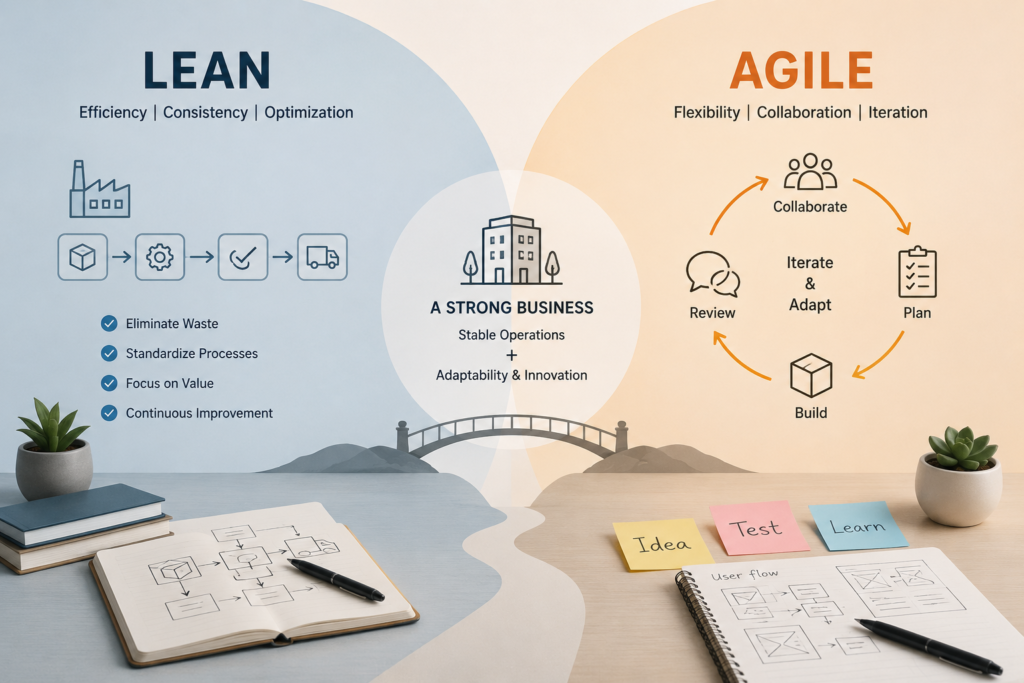
Hybrid Approaches: When You Need Both
Here’s something most articles won’t tell you clearly: most small businesses actually need a blend of both.
A pure Lean operation that never adapts becomes brittle. A pure Agile shop with no standardized processes becomes chaotic. The most successful businesses use Lean to build stable operational foundations, and Agile to stay flexible in areas where flexibility creates value.
What a Lean-Agile Hybrid Looks Like in Practice
Think of it in layers:
Layer 1 — Operations (Lean): Your core service delivery, onboarding, invoicing, fulfillment — these run on lean, documented, repeatable systems. Waste is minimized. Handoffs are clear. Quality is consistent.
Layer 2 — Projects and Development (Agile): When you’re launching a new service, running a marketing campaign, or developing a product — you work in sprints. You test, get feedback, and adjust before going all-in.
This combination is sometimes called LeSS (Large Scale Scrum), SAFe (Scaled Agile Framework), or simply a Lean-Agile hybrid depending on the context. You don’t need to follow a named framework rigidly — the principle is what matters.
A Simple Example
Imagine you run a boutique consulting firm with five team members.
Your client delivery process, intake, discovery, reporting, follow-up — runs on Lean. Every step is mapped, documented, and executed consistently. New team members can follow the system without you explaining it every time.
Your new service development, figuring out whether to add a new offering, testing a new pricing model, launching a workshop — runs on Agile. You run a pilot, collect feedback, iterate, and scale only what works.
Both methodologies coexist. Each one serves a different part of the business.
Common Mistakes Business Owners Make When Choosing a Methodology
Before you run off and implement either one, here are the most common traps to avoid.
Mistake 1: Treating methodology as a silver bullet. No framework solves a leadership problem, a culture problem, or a hiring problem. These tools work on top of a functional team, not instead of one.
Mistake 2: Copying what worked for someone else. Lean worked at Toyota. Agile was designed for software teams. Your bakery, your consulting firm, or your import business has different dynamics. Borrow the principles — adapt the execution.
Mistake 3: Implementing without buy-in. Both Lean and Agile require your team to actually use them. Dropping a new system on people without explaining the why or involving them in the how is a reliable way to make it fail.
Mistake 4: Going all-in before you understand the basics. You don’t need to implement the full framework on day one. Start with one core principle, apply it to one process, measure the result, then expand.
Frequently Asked Questions
Is Lean or Agile better for small businesses?
Neither is universally better — it depends on what problem you’re solving. Lean is better for operational consistency and cost efficiency. Agile is better for projects with evolving requirements. Many small businesses benefit from combining both.
Can a non-tech business use Agile?
Absolutely. Agile principles apply to any project-based work — marketing campaigns, client projects, service design, team planning. The core idea (short cycles, early feedback, continuous adjustment) works across industries.
How long does it take to implement Lean in a small business?
A basic Lean implementation — mapping one key process, identifying waste, and building a cleaner workflow — can show results in 4 to 8 weeks. Full cultural adoption takes longer, but early wins are visible quickly.
What’s the first step to applying either methodology?
Map what you currently do. Before you can improve a process, you need to see it clearly. Write out every step, who does it, how long it takes, and where things break down. That alone will show you where Lean or Agile thinking can help most.
Do I need a consultant to implement these?
Not always. But having someone help you diagnose the right fit — and avoid the most common mistakes — can save you months of trial and error, especially if you’re doing this for the first time.
Which Methodology Is Right for Your Business?
If you’ve read this far, you now have a solid understanding of both frameworks. But understanding them conceptually and knowing how to apply them in your specific business — with your team, your clients, and your current challenges — are two different things.
The most effective next step isn’t more research. It’s a focused conversation about your actual situation.
Sarah Moradi works with small business owners to diagnose operational gaps, identify the right frameworks, and build practical systems that actually get used — not just documented and forgotten. Through business consulting services, she helps founders move from a business that depends entirely on them to one that runs on clear, repeatable systems.
If you’re not sure whether Lean, Agile, or a hybrid approach fits your current stage, a Method Selection Session is the fastest way to get clarity without committing to a full implementation before you’re ready.
👉 Book a Method Selection Session — a focused, no-pressure conversation to figure out what your business actually needs next.
About the Author
Sarah Moradi is a business consultant and educator who helps small business owners build operational systems that let them grow without burning out. She works with founders across service, consulting, and product-based businesses to diagnose inefficiencies, implement practical frameworks, and create businesses that don’t depend entirely on the owner being present for every decision.
Great content! Keep up the good work!
Thank you!