

Almost every founder I talk to in Armenia asks some version of the same question in the first ten minutes: “but is the market even big enough?” It’s usually said with a slightly apologetic tone, like they already expect me to confirm their fear. Here’s my honest answer, and it’s the short version of everything below: population size is rarely why a business fails here. Skipping the work of finding out who you can actually reach, and whether enough of them will pay, is what fails. That’s what real Armenia market research looks like, and it has almost nothing to do with the country’s total headcount.
If you’ve been sitting on an idea and freezing every time you look at Armenia’s population number, this article is the exercise I’d walk you through in a planning session, minus the part where I ask you follow-up questions about your specific numbers.
Why “Armenia is small” is the wrong question
Armenia’s population sits at roughly 2.9 to 3 million people, depending on which statistical source you check (the UN’s estimate and Armenia’s own Statistical Committee land in slightly different places, which is normal for small countries). That number gets repeated a lot, usually as a reason to hesitate.
But no business, anywhere in the world, sells to the total population of its country. A children’s coding club in Yerevan doesn’t need three million customers. It needs maybe forty families who live within a reasonable commute, have a child in the right age range, care about the subject, and can afford the monthly fee. Three million is not your market. It never was, no matter which country you’re in.
The question worth asking isn’t “is Armenia big enough.” It’s “how many of the right people can I actually reach, and will enough of them buy.” Those are very different questions, and only one of them can be answered by looking at a population chart.
What Armenia’s numbers actually tell you (and what they don’t)
Some context is genuinely useful here, so let’s get it out of the way plainly.
About 1.1 million people, over a third of the country, live in and around Yerevan. That’s where most disposable income, most digital activity, and most competition are concentrated. If your idea depends on foot traffic, events, or in-person delivery, Yerevan is probably your real starting map, not the country as a whole.
Internet use is high for the region: roughly 80% of the population is online, and about 1.6 million people (a little over half the country) use social media, according to DataReportal’s 2026 digital report on Armenia. That matters if you’re planning to reach customers through Instagram, Facebook groups, or Telegram rather than a storefront.
Income is the part people underestimate. The average gross salary is around AMD 300,000 a month (roughly 780 dollars), but that average is pulled upward by a thin layer of high earners in IT and finance. The median, what a typical worker actually takes home, sits meaningfully lower, closer to AMD 220,000 to 275,000. If your pricing assumes the average, you may be pricing for a household that doesn’t represent most of your realistic customer base.
None of these numbers tell you whether your specific idea will work. What they do is stop you from making two opposite mistakes: assuming Armenia is too small to bother, or assuming “3 million people” means you have a huge open market. Neither is true. The real market is a slice, and it’s your job to define the slice before you spend anything.
Step 1: Define the reachable segment, not the whole country
Start narrowing on purpose. Geography first: where do these people physically live, and does your business model care? Then income band, because AMD 300,000 households and AMD 700,000 households make very different decisions. Then digital reach, because a segment you can’t find on the channels you can afford isn’t really reachable, even if it exists on paper.
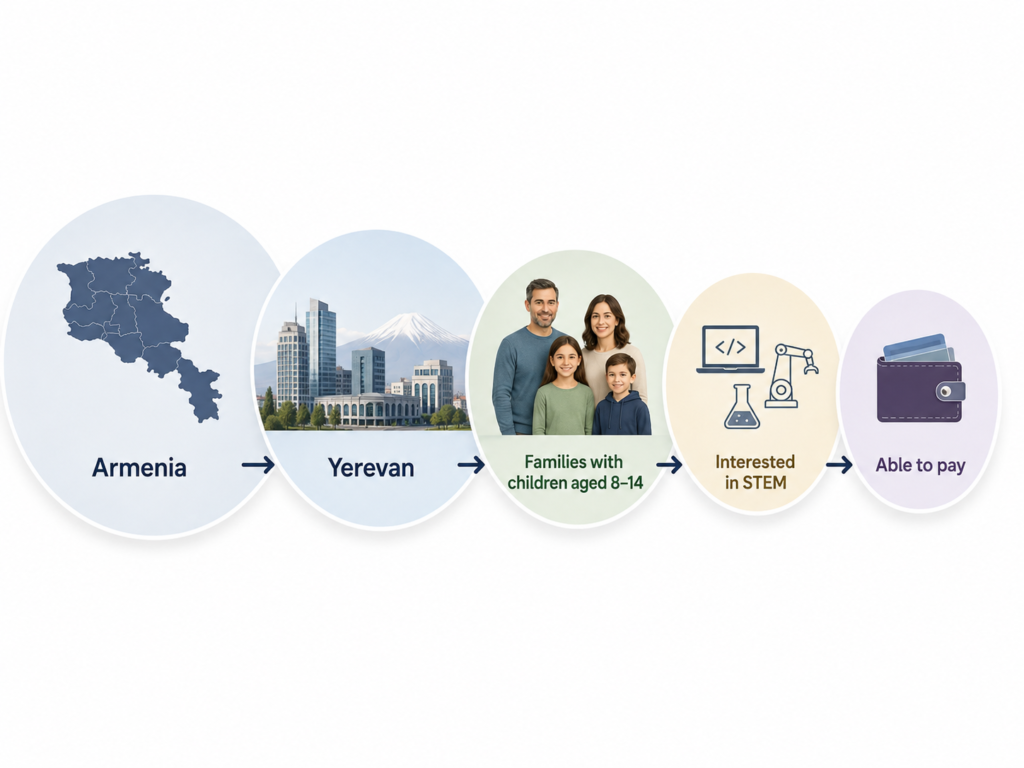
Take that children’s coding and robotics club idea. “Armenia” is not the market. “Yerevan” is closer. “Yerevan families with a child aged 8 to 14, some household disposable income, and existing interest in tech or STEM activities” is the actual segment, and it’s probably a few tens of thousands of households, not millions. That’s not a discouraging number. It’s a workable one, if the rest of the model holds up.
Write your segment down in one sentence. If you can’t, that’s usually the first real sign the idea needs more thinking before it needs money.
One more thing worth deciding at this stage: is your reachable segment purely local, or does it include people outside Armenia? Some businesses genuinely serve local households only. Others, especially anything sellable online or shippable, can reasonably include diaspora customers who already trust Armenian brands, or regional buyers in Georgia and beyond. Deciding this now changes your whole plan, not just your marketing later, so it belongs in the segment definition, not as an afterthought.
Step 2: Study how people already solve this problem
Your competition is rarely just the other business doing the same thing. It’s everything your customer currently does instead, including doing nothing at all.
For the coding club, that’s private tutors, free YouTube tutorials, other after-school activities competing for the same time slot, and plain inertia. Talk to a handful of parents about what they use now, why, and what frustrates them about it. This tells you two things at once: whether the problem is real enough that people are already spending time or money on it, and where your actual positioning should sit. If nobody is doing anything about the problem right now, that’s not automatically a green light. Sometimes it means there’s no felt need yet, which is a much harder (and more expensive) thing to create from scratch.
Step 3: Test willingness to pay before you build anything
This is the step most people skip, and it’s the one that actually protects your savings.
Asking “would you use this?” gets you polite yeses that mean almost nothing. People are generous with hypothetical enthusiasm and much more honest with their money. So instead of a survey, run something with a real cost attached: a single paid pilot session, a pre-order with a deposit, a waitlist that asks for a small non-refundable holding fee. For the coding club, that could be one paid Saturday workshop advertised to a tightly targeted parent group, priced close to what you’d eventually charge.
What you’re counting isn’t likes or comments. It’s how many people who saw the offer actually paid for it, and how that number compares to what you’d need on an ongoing basis. A pilot that gets eight paying families out of a targeted audience of 300 tells you something concrete. A survey that gets forty enthusiastic “yes, I’d love that” replies tells you almost nothing, because none of those people had to open their wallet.
If your idea is more product than service, a simple landing page with a real pre-order button works the same way. Build one page describing the offer, run a small, tightly targeted ad or share it directly in the right groups, and see how many people put down a deposit before the product exists. It costs a fraction of building the product first, and it answers the only question that actually matters at this stage: will strangers pay for this, not just tell you they like it.
Step 4: Map how you’ll reach your first ten customers, specifically
If you can’t name, right now, where your first ten paying customers would come from, that’s worth sitting with before anything else.
In Armenia, and especially in Yerevan, a lot of real customer discovery still runs through tight networks rather than cold digital ads. Parent groups on Facebook and Viber, school partnerships, word of mouth in a social scene that’s smaller and more interconnected than people expect from a capital city, community groups if you’re targeting returning diaspora specifically. I’ve watched founders spend their entire early marketing budget on generic ads that reached the right country but the wrong ten people, while a founder with almost no budget got their first dozen customers from one well-placed conversation in the right group.
This step forces specificity. “Social media marketing” is not a channel. “The Yerevan parents’ Facebook group with 40,000 members, posting twice a week and offering a discount for the first ten sign-ups” is a channel you can actually test this month.
Step 5: Decide what “big enough” actually means for your business
A market is big enough when it can support your fixed costs, at your price, with a customer count you can plausibly reach. That’s the whole definition. It has nothing to do with millions.
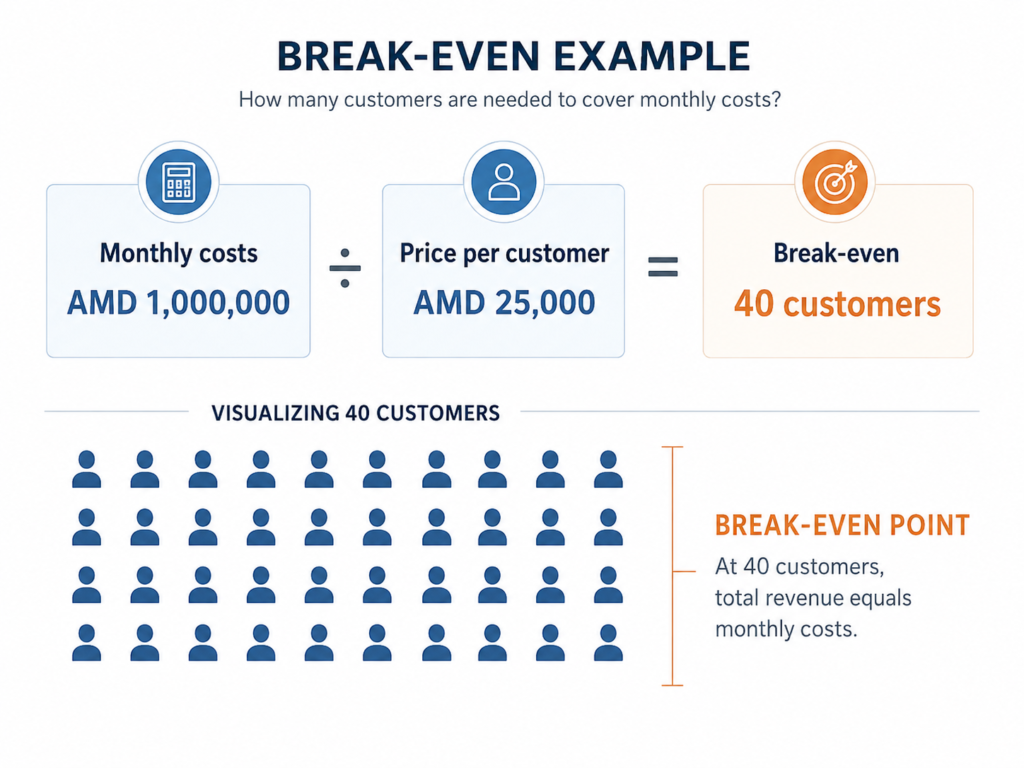
Rough version of the math, using the coding club again: say monthly costs (a small rented room, one instructor, materials) run around AMD 1,000,000. At AMD 25,000 per child per month, you’d need 40 paying families to break even, and meaningfully more to make it worth your time. Is 40 families realistic out of a Yerevan segment of tech-interested households with kids in that age range? Probably, if your reach-the-first-ten plan from Step 4 actually works. Is 400 families realistic in year one? Almost certainly not, and if your business plan quietly assumes something close to that, the market isn’t the problem, the assumptions are.
I want to be honest about the limits here: none of this guarantees your idea will succeed. Testing demand reduces risk, it doesn’t remove it. What it does is replace a vague fear (“Armenia is small”) with a specific, checkable claim (“I need roughly 40 paying customers from a segment of several thousand reachable households, and I have a channel to test that this month”). That second version is something you can actually act on.
Once you’re at that point, and you’ve decided the numbers hold up, the next useful thing to read is Starting a Business in Armenia: 8 Decisions to Make Before You Register, which covers the structural choices that come right after validation.
When the Armenian market genuinely is too small
I won’t pretend every idea fits. Highly specialized B2B software aimed at a narrow industry, very high-end luxury goods, and a handful of other categories genuinely don’t have enough reachable local demand to support a business on their own. That’s not a reason to give up on those ideas. It’s a reason to design them for export, remote clients, or diaspora and regional customers from day one instead of assuming local demand will eventually catch up. Some of the most resilient business opportunities in Armenia are built exactly this way: local costs, non-local revenue.
A few questions people usually ask at this point
Do I need to reach all of Armenia for my business to work? Almost never. Most viable businesses here need a specific, well-defined segment, often concentrated in and around Yerevan, not the entire country’s population.
Do I need an expensive market research firm to do this? Not for the first pass. A defined segment, a handful of honest customer conversations, and one small paid pilot will tell you more than a generic report, and cost far less.
What if my pilot doesn’t get enough paying customers? That’s useful information, not a failure. It usually means the segment, the price, or the offer needs adjusting, and it’s much cheaper to learn that from a AMD 200,000 pilot than from a year of rent and inventory.
Should I do this before or after writing a full business plan? Before, or alongside it at the very earliest stage. A business plan built on an untested assumption about demand just documents the guess more formally. Test first, then plan around what you actually learned.
Where to go from here
If you’ve worked through the steps above and your idea still holds up on paper, the honest next move isn’t more solo research. It’s putting your specific numbers, segment, and channel plan in front of someone who can stress-test them before you sign anything. That’s exactly the kind of conversation I have with founders every week.
Ask About Business Planning Support if you’d like to work through your own numbers before you commit to registering or renting anything.