

Most small business owners track the wrong numbers, and wonder why they feel busy but not growing.
Business KPIs (Key Performance Indicators) are the metrics that tell you whether your business is actually moving in the right direction. Choose the right ones, and they become your roadmap. Choose the wrong ones, and you’re just collecting data that doesn’t lead anywhere.
In this article, I’ll walk you through how to pick KPIs that are genuinely useful, which ones most small businesses get wrong, and how to set up a simple dashboard you’ll actually use.
Why Business KPIs Matter (And Why Most People Get Them Wrong)
KPIs matter because you can only improve what you measure, but measuring the wrong things creates false confidence.
I see this constantly with the small business owners I work with. They’re checking their social media follower count every day while having no idea what their customer acquisition cost is. Or they’re obsessing over revenue without knowing their profit margin per product line.
Here’s the thing: a number without context is just noise.
KPIs turn raw data into decisions. They tell you:
- Where your business is healthy
- Where it’s bleeding money or time
- What to fix first
- When a strategy is actually working
Without them, you’re managing by gut feeling, which works until it doesn’t.
The difference between a metric and a KPI
Not every metric is a KPI. A metric is any data point you can measure. A KPI is a metric that’s directly tied to a goal you care about.
Page views are a metric. Conversion rate from page views to booked consultations is a KPI. One tells you something happened. The other tells you if it mattered.
How to Select the Right Business Metrics for Your Stage
The right KPIs depend on your business model, your current growth stage, and what decision you’re trying to make.
There’s no universal list that works for every business. A freelancer, a product company, and a service firm all have different levers. Here’s a framework that works across most small businesses:
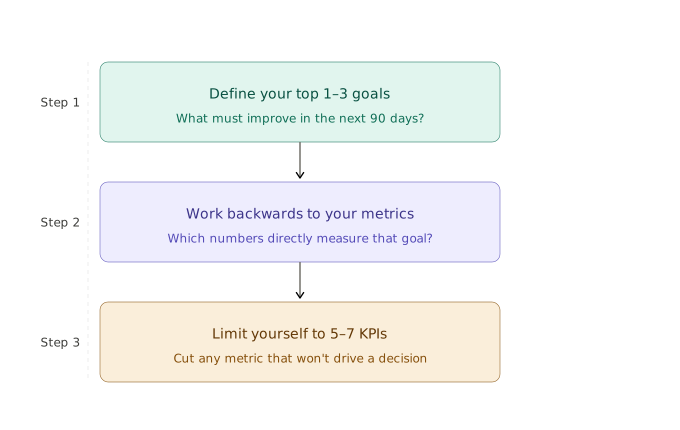
Step 1: Start with your business goal
Before you choose any metric, write down your top 1–3 business goals for the next 90 days. For example:
- Increase monthly recurring revenue by 20%
- Reduce client churn below 5%
- Cut operational costs without cutting output quality
Your KPIs should be direct measurements of progress toward those goals, nothing else.
Step 2: Work backwards from the goal
If your goal is to increase monthly revenue, your KPIs might include:
| KPI | Why It Matters |
|---|---|
| Number of new leads per week | More leads = more potential clients |
| Lead-to-client conversion rate | Shows how well your sales process works |
| Average project value | Reveals whether you’re pricing correctly |
| Client lifetime value (LTV) | Shows long-term revenue potential |
Step 3: Limit yourself to 5–7 KPIs
This is the hardest part. Most business owners want to track everything. But when everything is important, nothing is.
Pick 5–7 metrics maximum. Review them weekly or monthly. If a KPI isn’t driving a decision, cut it.
KPIs worth tracking for most small service businesses
Financial KPIs:
- Monthly recurring revenue (MRR) or monthly net revenue
- Gross profit margin
- Operating cash flow
Client & sales KPIs:
- Number of active clients
- Lead conversion rate
- Client retention rate
Operational KPIs:
- Billable hours vs. total hours (efficiency ratio)
- Project delivery time vs. estimated time
- Team utilization rate
Common KPI Mistakes Small Businesses Make
The biggest KPI mistake is tracking what’s easy to measure instead of what actually matters.
Here are the pitfalls I see most often, and how to avoid them.
Mistake 1: Vanity metrics masquerading as KPIs
Website traffic, social media likes, and email open rates feel important. Sometimes they are. But if they’re not tied to a specific business outcome, they’re just feel-good numbers.
Ask yourself: “If this number doubled tomorrow, would it change how I run my business?” If the answer is no, it’s probably a vanity metric.
Mistake 2: No baseline, no benchmark
A 15% conversion rate means nothing if you don’t know what it was last month or what the industry standard is. Always establish a baseline before you start tracking, and find benchmarks for your industry.
Mistake 3: Tracking too many things at once
When you have 30 metrics on a dashboard, you end up scanning them and feeling vaguely informed, but not actually making decisions. Fewer, better KPIs create focus.
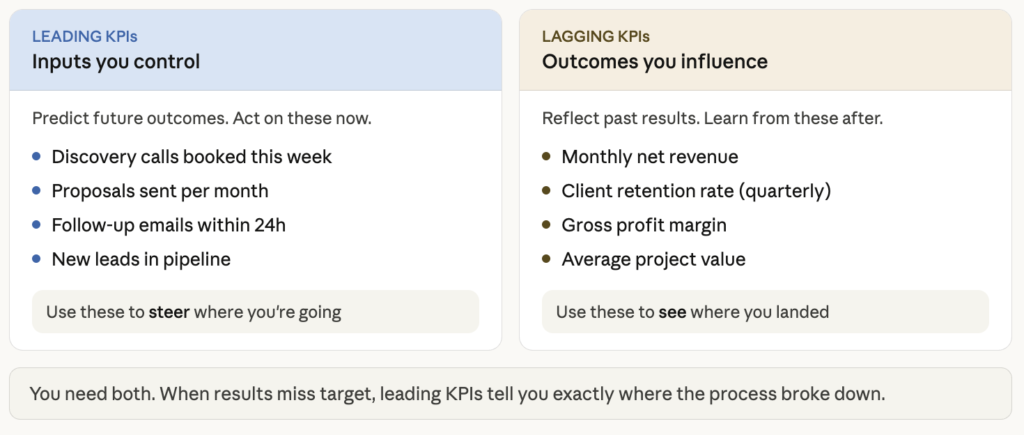
Mistake 4: Measuring outcomes but not inputs
Revenue is an outcome. The number of sales calls made this week is an input. You can control inputs. You can only influence outcomes.
Track both — but when things go wrong, the input metrics tell you where to fix the problem.
Mistake 5: Setting KPIs and never reviewing them
A KPI is only useful if you review it on a schedule and ask: what does this number tell me to do differently? Build a weekly or monthly review habit. Without it, the data just sits there.
How to Build a Simple KPI Dashboard That You’ll Actually Use
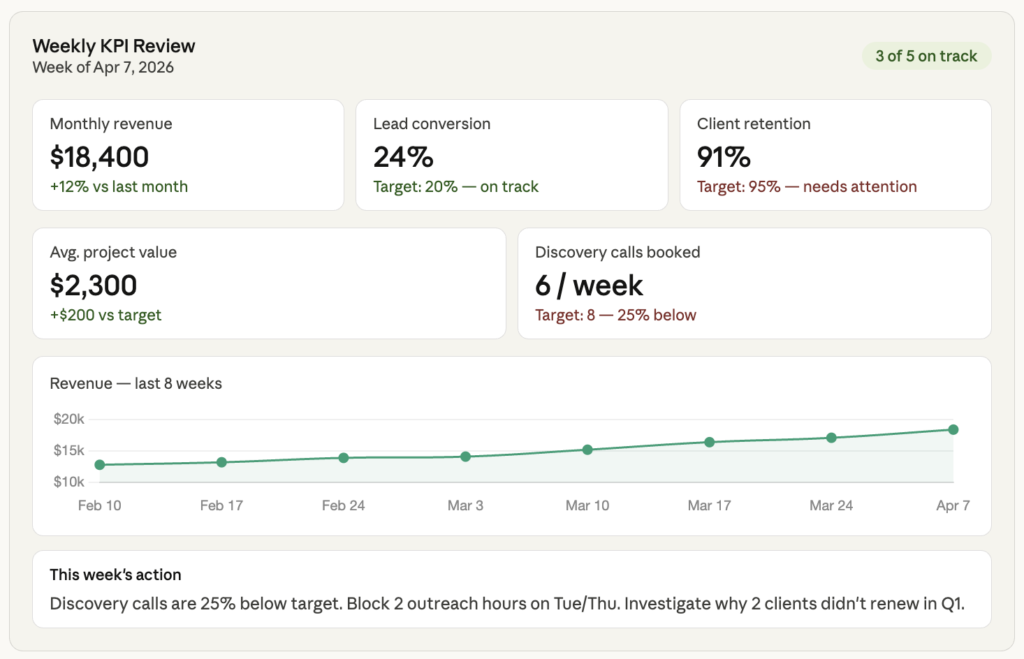
A good KPI dashboard shows your 5–7 most important metrics in one place, updated regularly, and formatted so decisions are obvious.
You don’t need expensive software to start. Here’s how to build one that works.
Choose your tool
For most small businesses, one of these three options works well:
| Tool | Best For | Cost |
|---|---|---|
| Google Sheets | Full control, free, easy to share | Free |
| Notion | Teams that already use Notion | Free / paid |
| Looker Studio | Pulling from multiple data sources | Free |
| Databox / Klipfolio | Automated, visual dashboards | Paid |
Start with Google Sheets. You can always upgrade later.
Structure your dashboard
A simple, effective dashboard has three sections:
- At a glance — Your top 3 numbers this week vs. last week
- Trend view — A simple chart showing the last 12 weeks or months
- Action list — What does this data tell you to do this week?
That last column is what most dashboards skip, and it’s the most important part.
Set a review rhythm
- Weekly: Check your operational and sales KPIs (15 minutes max)
- Monthly: Review financial KPIs and compare to your goals
- Quarterly: Decide if your KPIs still match your current business goals
The review rhythm matters more than the dashboard design. A simple spreadsheet reviewed consistently beats a beautiful dashboard that nobody opens.
What to include in each KPI entry
For every KPI on your dashboard, document:
- What it measures (definition)
- Current value
- Target / benchmark
- Owner (who’s responsible for this number)
- Data source (where does this number come from)
This eliminates confusion when a number looks unexpected.
Frequently Asked Questions About Business KPIs
What are the most important KPIs for a small business?
The most important business KPIs depend on your goals, but most small businesses should track: monthly net revenue, profit margin, client acquisition cost, client retention rate, and lead conversion rate. These five cover your financial health, sales efficiency, and client relationships.
How often should I review my KPIs?
Review operational and sales KPIs weekly, financial KPIs monthly, and strategic KPIs quarterly. The frequency should match how quickly the metric changes and how fast you need to respond.
What’s the difference between a leading and lagging KPI?
Lagging KPIs measure past results (like revenue). Leading KPIs measure inputs that predict future results (like number of discovery calls booked). You need both, lagging to see where you landed, leading to steer where you’re going.
How many KPIs should a small business track?
Between 5 and 7 KPIs is the right range for most small businesses. Any fewer and you’re flying blind; any more and the dashboard becomes overwhelming. Choose quality over quantity.
Can I use KPIs if I’m a solo business owner?
Absolutely. KPIs are especially useful for solo operators because there’s no team to catch what you miss. Even tracking 3–4 core metrics weekly can transform how clearly you see your business.
Ready to Figure Out Which Metrics Actually Matter for Your Business?
Knowing which KPIs to track is one thing. Setting them up correctly for your specific business model, goals, and stage is another.
If you’d like help identifying the right metrics and building a dashboard that drives real decisions, our business consulting services are designed exactly for this — practical, no-fluff guidance for small business owners who want to grow with clarity.
Book a metrics assessment →
We’ll map out your current numbers, identify the gaps, and give you a simple KPI framework you can start using immediately.
Updated: April 2026
Written by Sara Moradi, business systems consultant and advisor helping small business owners build structured, scalable operations.