

If you want to get paid from abroad in Armenia without losing money to a rejected transfer or three weeks of chasing your own invoice, the real work happens before you pick a payment method. Most freelancers and small business owners here do it backward. They sign the client, do the work, then scramble to figure out how the money will actually reach them. By that point, half the decisions that would have made the payment smooth are already behind them.
For freelancers and small business owners working with international clients, the work itself may go smoothly while the payment process becomes the unexpected problem. A client can be happy, an invoice can be approved, and the money can still get delayed somewhere between “sent” and “received” because the payment route, documentation, or bank requirements were never clarified in advance.
This isn’t a list of the best apps for receiving money, and it won’t rank providers for you. It’s a map of everything that has to line up before you ever open a payment app, so you can build a process that holds up on the fifth payment and the fiftieth, not just the first.
Start With How Your Client Prefers to Pay, Not With What You Prefer
Your client’s location, internal accounting rules, and procurement process usually decide the payment method before you have much say in it. A finance department in the US may only be authorized to pay through specific bank rails. A solo founder in Germany might prefer a simple payment link. Ask before you assume your favorite platform will work on their end.
Imagine a freelance designer in Gyumri who has built her invoicing process around the platform her first client happened to use. Her next client, a European agency, only pays international contractors by bank transfer. Suddenly, a payment method that worked perfectly for one client becomes a project delay for the next. The problem isn’t the platform or the bank transfer. It’s that nobody clarified the payment process before the work began.
The fix is embarrassingly simple. Before you sign anything, ask the client, or their finance contact, how they typically pay international contractors. You’ll usually get one of three answers: bank wire, a platform they already use for other contractors, or “whatever’s easiest for you.” Only the third answer actually leaves the decision in your hands.
Put the Payment Terms in the Contract, Not Just the Invoice
An invoice describes what’s owed. A contract gives both sides an agreed reference point for how, when, and in what currency that amount should be paid.
Currency, who absorbs transfer fees, the payment deadline, and what happens if a transfer is delayed by compliance checks all belong in the agreement, not somewhere you assumed everyone agreed on.
A lot of service agreements I’ve seen here spell out scope and price in careful detail and say almost nothing about the mechanics of payment. That gap becomes a problem the moment something goes sideways: a wire gets flagged for extra review, the client’s bank asks for more documentation, or the exchange rate shifts enough that “the same amount” suddenly isn’t. If the contract already states the currency and who covers intermediary bank fees, you’re negotiating from something agreed weeks earlier, not arguing about it while the money sits somewhere in transit.

Decide Which Currency You Actually Want to Receive
The practical question is which currency your business actually needs. If most of your expenses are in AMD, you’ll eventually need to convert at least part of what you receive. If you also have recurring expenses in USD or EUR, converting everything immediately may simply create another conversion later.
Look at your expense mix, how often you’re paid, the currencies your clients use, bank fees, and how much currency exposure you’re comfortable carrying between payments. Then confirm with your accountant how foreign-currency income should be recorded for your specific business and tax regime.
Understand the Route the Money Will Actually Travel
A payment from a foreign client to your Armenian account usually takes one of three routes: a direct bank wire through the SWIFT network, a payment platform built for freelancers and small exporters, or a payout through a marketplace you’re already working on. Each one moves at a different speed, with a different fee structure and different paperwork behind it.
Bank wires are familiar and widely used, but international transfers may pass through one or more correspondent banks before reaching your Armenian account. Timing and fees can vary depending on the currency, the sending bank, the correspondent route, cut-off times, and whether additional checks or documentation are required.
Payment platforms built for freelancers can move smaller amounts faster, though not all of them support payouts to Armenian accounts or accept businesses registered here, and that changes often enough that it’s worth confirming directly with the provider rather than building your whole process around what worked last year. Marketplace payouts handle a lot of this for you automatically, but you’re still responsible for matching what lands in your account against what your invoice actually said, especially once platform fees are subtracted.
None of this is an endorsement of one option over another. What matters is that you know, before the first invoice goes out, which route the money will take and roughly how long it should take to arrive.
Ask About Fees Before the First Invoice, Not After
International payments usually carry three layers of cost: a sending fee charged by the client’s bank or platform, a receiving or intermediary fee on your end, and a currency conversion margin that’s often folded into the exchange rate instead of listed as its own line. Small transfers absorb these costs the hardest, proportionally speaking.
A $150 invoice can lose a meaningful slice of its value to fees that would barely register on a $5,000 one. If you’re doing smaller, more frequent work, that’s worth building into your pricing rather than treating as an unpleasant surprise every time you check your balance. Ask your bank directly what they charge on incoming international transfers, and whether that’s a flat fee or a percentage. Ask your accountant how transfer fees and foreign-currency transactions should be documented in your records. Neither question takes long, and both save you from guessing later.
Know When a Transfer May Need Additional Review
Some incoming international transfers may take longer when a bank needs additional information about the sender, the purpose of the payment, or the underlying transaction. Depending on the bank and the transaction, you may be asked for supporting documents before the payment can be processed or made available.
Ask your bank in advance what documentation it may request for business-related incoming transfers. Keeping contracts, invoices, and other supporting documents accessible can make it much easier to respond if additional information is requested.
Plan for Refunds and Disputes Before You Ever Need Them
Bank transfers generally don’t come with the same built-in dispute or chargeback process found on many payment platforms and marketplaces, although recalls, returns, or other corrective processes may still be possible depending on the banks and circumstances involved. Platforms and marketplaces may have their own dispute and refund procedures, so it’s worth understanding those rules before relying on one for client payments.
Decide in the contract what happens if a client disputes a payment or asks for a partial refund after delivery. Would you offer something back voluntarily under specific conditions? Knowing which risk profile you’re actually operating under changes how comfortable you can be delivering work before payment fully clears, and it’s a conversation worth having before there’s ever a disagreement to resolve, not during one.
Keep Records an Accountant Can Actually Use
A practical record set for an incoming payment may include the agreement or contract, the invoice or other relevant settlement document, the payment confirmation, and bank records showing any fees or currency conversion. Keeping these documents together makes it much easier to match a payment to the work it relates to and gives your accountant a clearer trail to work with.
Don’t assume that the exchange rate used when you eventually convert the money is automatically the rate used for Armenian tax reporting. Armenian tax rules contain specific provisions for translating foreign-currency transactions into AMD. Depending on the transaction, the relevant date may be tied to the settlement document or another document related to the transaction. Confirm the correct treatment with your accountant for your business and tax regime, and keep the relevant documents together from the start.
Never Rely on a Single Payment Route
Having only one way to receive money makes your business more vulnerable to provider changes, additional verification, or problems with a particular transaction. A backup route becomes especially valuable when international client payments are a significant part of your business income.
The problem usually becomes visible at the worst possible time: when a provider changes its requirements, an account needs additional verification, or a particular transaction can’t follow the route you normally use. If international client payments are a significant part of your income, having a second workable route reduces your dependence on any single provider.
Set up your second route now, send a small test transfer through it if you can, and keep the details somewhere you’d actually remember to look under pressure.
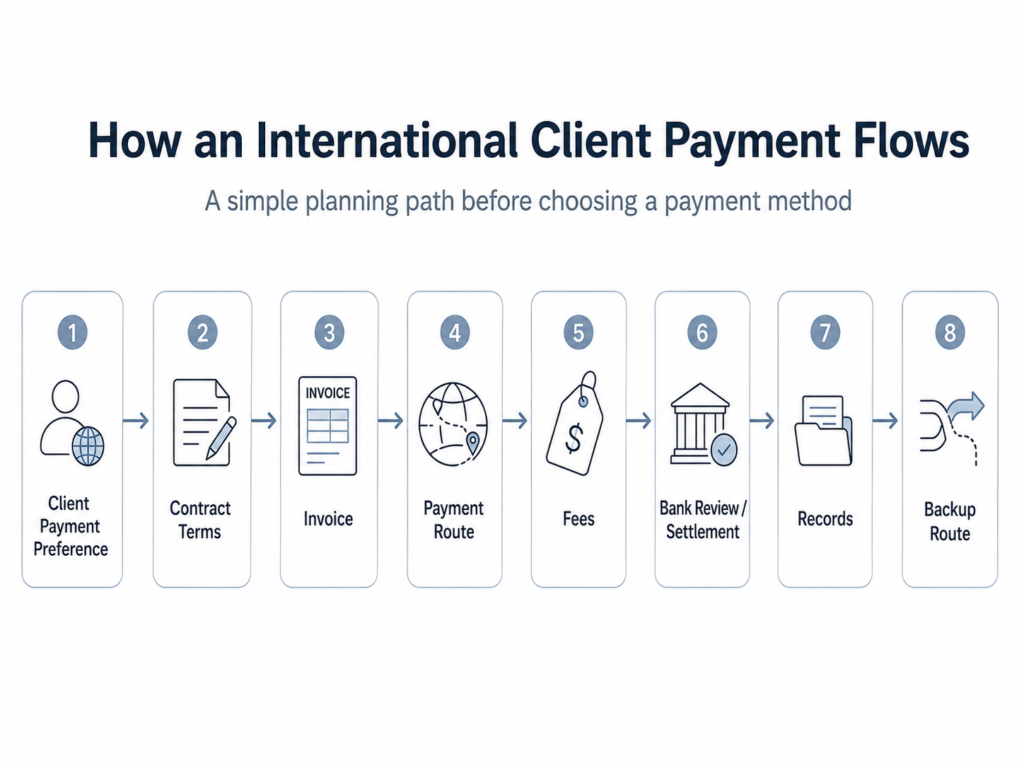
Walking Through the Full Journey, Start to Finish
It helps to see the whole path in order, rather than as separate decisions scattered across different conversations:
- Client states or is asked about their preferred payment method.
- Agreement is signed with currency, fees, and deadlines written in, not assumed.
- Invoice is issued matching exactly what the contract says.
- Currency decision is made on whether to hold, spend, or convert.
- Processing route carries the payment (bank wire, platform, or marketplace).
- Fees are deducted at one or more points along that route.
- Receipt and review: the payment reaches your bank, with additional information or documentation provided if required.
- Records are saved and matched: agreement, invoice or settlement document, payment confirmation, and relevant bank records.
- Backup route sits ready in case step five ever breaks down.
Miss a step, and the ones after it get harder to fix retroactively. Get all nine in order once, and every payment after that follows the same, mostly boring, reliable process.
Questions Worth Asking Your Bank and Accountant Before You Commit
Bring this list to your next conversation with either one:
- What documentation do you need from me for incoming international payments, and does that change above a certain amount?
- What’s your fee structure for receiving foreign currency, fixed or percentage-based?
- Which exchange rate and transaction date should I use when recording foreign-currency income for tax and accounting purposes?
- What may lead you to request additional information or documents for an incoming international transfer, and what should I keep ready?
- If a payment gets rejected or returned, who absorbs the fees involved?
- What records do you need from me for tax purposes on foreign client income?
Putting It All Together
None of this is complicated on its own. Where people get stuck is treating each piece as a separate, one-off question instead of a single process that has to hold together, from the moment a client agrees to work with you to the moment the payment is fully recorded in your books. Map it once, in order, and choosing an actual payment method takes about ten minutes, because everything it depends on is already decided.
If you haven’t registered your business yet, or you’re still weighing how to structure it, several of the decisions in Starting a Business in Armenia: 8 Decisions to Make Before You Register directly affect how foreign payments and taxes work for you down the line. It’s worth reading before you lock in a payment process, not after.
If your situation involves multiple clients, multiple currencies, or a business structure you’re still not sure fits what you’re actually doing, that’s exactly the kind of thing worth working through with someone looking at your specific setup rather than general guidance. Contact Us to Discuss Your Business Situation.
A note on this article: This is general information based on common practice and publicly available sources, not legal, tax, accounting, or banking advice. Currency regulations, banking compliance requirements, and provider availability in Armenia change over time, and your specific business structure and client mix will affect what actually applies to you. Confirm current terms directly with your bank, and speak with a licensed accountant or legal advisor before making decisions based on anything above.