

You have a product people would probably buy. You just don’t know anyone yet.
That’s the part nobody warns you about when you decide to enter a new market. Not the paperwork, not the pricing, not even the competition. It’s the silence. You post, you email, you wait, and nothing happens, because nobody in this market has any reason to trust you yet. I’ve watched this play out with founders again and again: they build something solid, they move into a new city or country, and then they try to run customer acquisition the same way they already know how to. It doesn’t work the same way. When you have no reputation and no network, customer acquisition becomes less about reach and more about earning enough trust to start a conversation.
The good news is that this is solvable, and it doesn’t take years to fix. It takes a different order of operations.
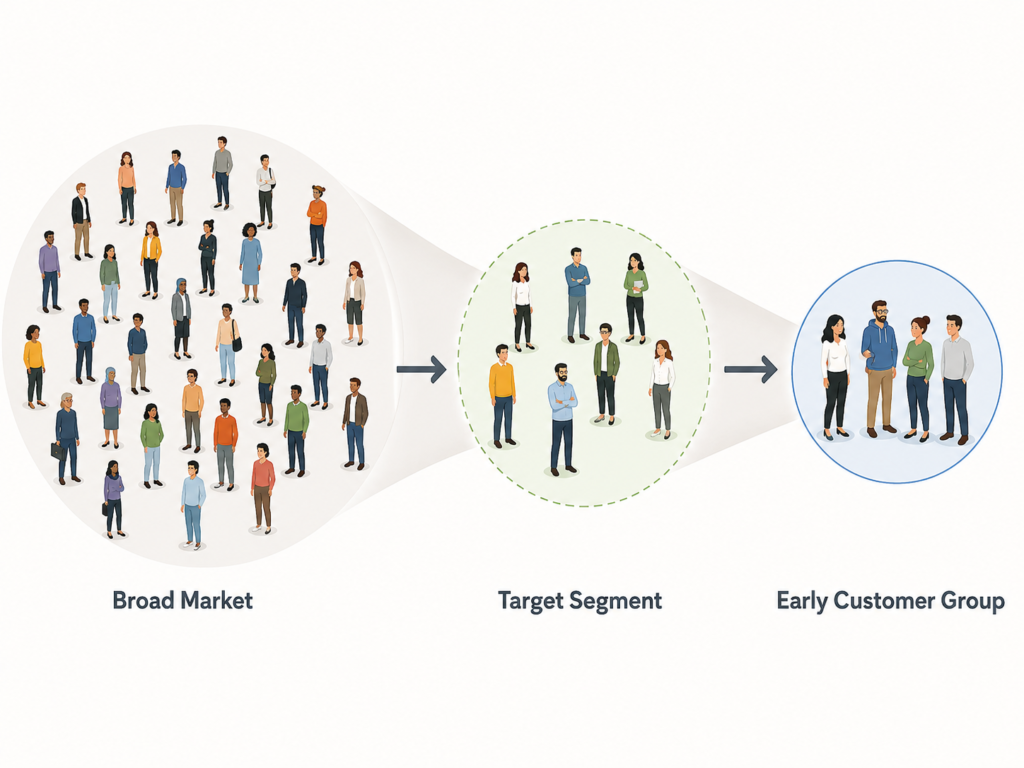
Start With One Narrow Slice, Not “Everyone Who Might Buy”
When you have no reputation, broad targeting works against you. “Small business owners” or “people who like healthy food” is too wide a net to build trust with, because nobody inside a vague, giant group feels like you’re speaking to them specifically.
Pick something narrower than feels comfortable. If you’re launching a specialty pet food brand, don’t aim for “pet owners.” Aim for “owners of senior dogs who follow raw-diet vets online.” That’s a group small enough to actually reach, and specific enough that your message lands instead of bouncing off.
A narrow segment also does something else: it makes referrals possible. People refer other people who are similar to them. If your first ten customers are wildly different from one another, it becomes much harder to create a repeatable referral loop. There is no clear “someone like me” for your customers to picture when they think about who else might benefit from what you offer.
Don’t Assume Your Offer Translates Automatically
What worked in your previous market may not work in exactly the same form somewhere new. The product might still be relevant, but the way people describe the problem, what they value most, what feels expensive, or what makes them hesitate can be different.
Use your first conversations to test more than demand. Pay attention to which part of your offer gets questions, which benefit gets the strongest reaction, and where people lose interest. You may find that you don’t need a different product at all. You may just need a different message, package, price point, or entry offer.
At this stage, those conversations are part of your market research. Don’t rush to scale a message you haven’t yet proven people in this market understand and care about.
Give People Something to Look At, Not Just a Pitch
Trust doesn’t come from a good explanation. It comes from evidence. In a market where nobody has heard of you, the fastest way around the trust problem is to give people something tangible before you ask for anything.
A founder I worked with was bringing a small furniture line into a new city. Instead of cold-emailing interior designers with a catalog, she dropped off three physical samples at four studios, no pitch attached, just a note asking for honest feedback. Two of those studios started specifying her pieces in client projects within a month. Nobody had to take her word for anything. They could see and touch the product.
Not every business can hand someone a physical sample, but the principle holds. A short demo, a free trial, a small pilot project, even one case study with real numbers, all do the same job: they replace “trust me” with “see for yourself.”
Find the Two or Three People Everyone Already Trusts
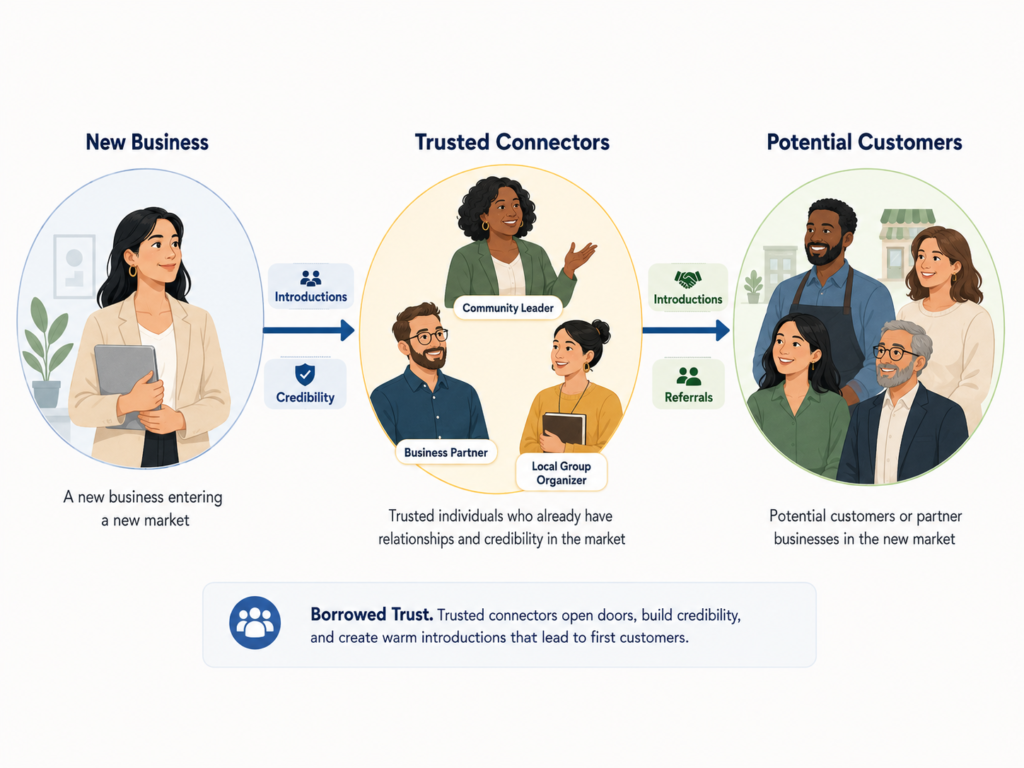
Every market, no matter how unfamiliar it feels to you, already has trust running through it. It’s just not running through you yet. It’s running through connectors: the person who runs the local business group, the admin of the Facebook or Telegram community, the supplier everyone already buys from, the association that hosts the monthly meetup.
Your job isn’t to build trust from zero. It’s to find the two or three people who already have it and earn a place in their circle. That usually means showing up before you ask for anything. Join the group. Go to the event. Answer someone else’s question in the community before you post your own. Connectors notice who’s genuinely present and who just showed up to sell.
Partnerships Can Move Faster Than Advertising When You’re New
Paid ads can help you reach people quickly, but reach is not the same as trust. In a market where you’re still unknown, an ad may get attention without giving the customer enough context to take the next step. That’s why partnerships can be especially valuable early on: they add an existing relationship to the introduction.
Partnerships skip that problem. If you can find a business that already serves your ideal customer without competing with you directly, a joint offer, a bundled deal, a simple cross-referral, gets you introduced by someone the customer already trusts. A skincare brand entering a new country might partner with a local salon before it ever runs an Instagram ad. The salon’s existing relationship does work that an ad campaign would take months to build.
Just Ask for the Introduction
This step sounds obvious, and it’s the one founders skip the most, usually because asking directly feels awkward. But a vague ask gets a vague response. “Let me know if you know anyone who’d be interested” almost never leads anywhere, because you’ve handed the other person the job of figuring out who to think of.
Be specific instead. “Do you know anyone running a boutique gym who’d want to test this?” gives someone an actual person to picture. It’s a small difference in phrasing, and it changes whether the introduction happens at all.
Direct Outreach That Doesn’t Read Like Spam
Cold outreach still works, just not the version most people send. A message that could be copy-pasted to five hundred people gets ignored by all five hundred, because the recipient can tell instantly it wasn’t written for them.
Keep the list small and the research real. At this stage, ten well-researched messages, each mentioning something specific about that person or their business, are often more valuable than two hundred generic ones.
You’re not running a numbers game at this stage. You’re trying to start actual conversations, and conversations require the other person to feel like an individual, not a line in a spreadsheet.
What This Looks Like in Armenia
Armenia is a useful example because its relatively compact market makes relationships, reputation, and word of mouth particularly visible. Many of the principles above show up here very clearly.
The market is compact enough that word travels fast, in both directions. A good early customer experience gets mentioned; a bad one gets mentioned faster. That makes the “give people something to look at” step even more important here than in larger markets, since there’s less room to hide a mediocre first impression behind volume.
In many parts of Armenia’s business community, personal introductions can carry considerable weight, especially when you’re still unknown in the market. A strong website still matters, but it may not replace the credibility that comes with a trusted introduction.
Business associations, industry-specific Telegram groups, and expat or diaspora networks act as the connectors described above, and they’re active enough that showing up consistently in one or two of them will do more for you than being present everywhere thinly.
Language can also affect how quickly people respond to you. Depending on your audience, Armenian, Russian, or English may be the most effective language for the first conversation. In some sectors, particularly international business and technology, English may work perfectly well; in others, using Armenian or Russian for key messages can reduce friction and make the business feel more locally aware. You don’t need to translate everything on day one, but it is worth testing which language your target customers actually prefer.
Partnerships can also be particularly effective here because many business networks are relatively interconnected. Once you’ve earned credibility with the right people, introductions can open doors that would be much harder to reach through cold outreach alone.
Measure Conversations, Not Followers
It’s easy to confuse activity with progress. Impressions, likes, and follower counts feel like momentum, but none of them tell you whether you’re any closer to a customer.
Track what actually matters at this stage: how many real conversations you started this week, how many samples or demos you gave out, how many people asked a follow-up question instead of going quiet. Those numbers are smaller and less satisfying to look at, but they’re the ones that eventually turn into your first sale, and your first sale is the only metric that proves any of this is working.
A simple weekly scorecard is enough. Track:
- relevant people contacted
- replies received
- real conversations started
- demos, samples, or pilots offered
- introductions or referrals received
- first purchases
You don’t need dozens of metrics. You just need enough visibility to see where people are dropping out. If you’re getting replies but no meetings, your message may be the problem. If you’re getting conversations but no trials or purchases, the offer may need work.
Where to Go From Here
Finding your first customers in a new market isn’t about picking the one perfect channel. It’s a handful of small, deliberate moves, done in the right order, aimed at a group small enough that trust can actually form. Start narrow, learn from real conversations, create evidence, borrow trust where you can, and only then think about scaling what works.
If you’re still weighing whether your business needs a full growth plan at this stage or just clarity on the next move, this article on Business Diagnostic vs. Business Plan: What Does Your Small Business Need First? is a good next read.
And if you’re entering the Armenian market specifically and want a second set of eyes on where to start, reach out to Novamentis. We work with founders navigating exactly this stage.